Guillaume Thunis
Guillaume Thunis
Guillaume Thunis
Born 1991 in Belgien, lives and works in Belgium
Represented by the Galerie La Ligne since 2026
Guillaume Thunis. Drawing the Seconds
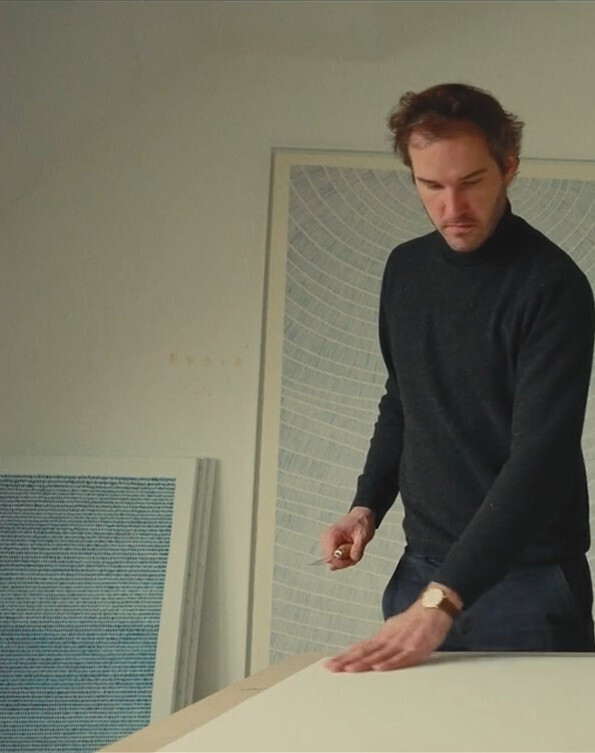
At first glance, one might think that Guillaume Thunis is seeking to capture the moment. Nothing could be further from the truth. What he shapes, with a craftsman’s patience, is a duration. Through the methodical, almost meditative repetition of basic gestures (a dot that takes root, a line that stretches, a grid that is woven), the artist establishes clear structures. But beneath the rigour of the process, a breath circulates. It is the micro-deviations, those joyful little betrayals of the hand, that bring the sheet to life. Between ruler and vibration, control and breath, the paper becomes the vessel of a time that is no longer counted, but written.
In Praise of Repetition
Repeat. Persist. Start again. In Guillaume Thunis’s work, drawing is a matter of gentle obstinacy: a gesture tested and refined until repetition itself enriches his composition, allowing variations as subtle as they are unpredictable to emerge. Like a musician practising their scales to set their soul free, the artist works on a movement, not to harden it, but to open it up. Faced with the simplicity of his work, one is reminded of a eulogy to repetition. Not the kind that wearies or lulls, but the kind that steadies the mind to better welcome the surge of a tremor. The dots multiply, the lines brush against one another, the streaks become tamed. Within this apparent rigour, an organic tremor surfaces, for nothing here is ever strictly identical. This exploration is rooted in a deliberately restrained framework. Ink and paper are his only confidants. Far from the spectacular, the artist rejects grand gestures. He prefers the simplicity of a grid, the poetry of a mosaic or the precision of a constellation of dots which, through accumulation, ultimately delineate a territory. A patient geography made up of thresholds and passages.
The fragility of the living
Guillaume Thunis plays with the codes of planning: one thinks one can make out a map, an urban plan, an attempt to tame reality through geometry. Yet the reading is constantly thwarted, leaving our eye trapped in a double focus. From a distance, the structure imposes its logic (a whole, an organisation, a diagram). Up close, we discover its vulnerability. Small, almost imperceptible deviations shift the balance, causing the symmetry to waver, thereby highlighting the fragility of life. This tension creates a haunting kinship with the physical world. His motifs may evoke textile, the texture of skin, the memory of successive layers, whilst remaining within the realm of abstraction. But this abstraction is not an aesthetic stance. It is an experience. An experience of time. To look at these drawings is to agree to slow down. Each composition is an archive of the hand’s passage: an intimate calendar that counts not the hours, but the estures and the heartbeats.
Paper as a partner
Reducing one’s means is no mere pretence of asceticism. On the contrary, this economy creates the conditions for intensity. For Guillaume Thunis, paper is never a neutral medium. It is an accomplice: more sensitive, more receptive than canvas, it absorbs the ink, sometimes resists, becomes saturated, stains. It retains in its memory the pressure of the pen, but also every hesitation, every certainty. The gesture then becomes writing. A scriptural typography, a grammar of the minute that is not unreminiscent of Eastern calligraphy. Here we find that attention to the breath, that idea that a single stroke engages the whole body. At times, automatic writing lies in wait. When attention slacks without vanishing, the hand takes the upper hand. At that moment, time seems to fade away… yet paradoxically retains the urgency of a fragile present to be inhabited. Even the margins, far from being reduced to blank or peripheral areas, act as active thresholds: they intensify the window of expression they define. It is within this space that Guillaume Thunis explores the notion of saturation. An almost organic saturation, as if the sheet were reminding us, in its own way, that nature abhors a vacuum.
Patience as resistance
Through this discipline, the artist’s approach resonates as a quest for a liveable balance between the need for control and the desire to let go. Guillaume Thunis moves forward like a tightrope walker. Nothing is more constructed, and yet, nothing is more unstable. In contrast to the image that is consumed as much as it consumes itself, his work imposes a policy of attention. It chooses living certainty and the beauty of imperfection. It is a physical work, almost performative, sustained day after day with exemplary tenacity. A silent testament to the fact that patience can emerge, not as an abstract virtue, but as a form of commitment that brings with it the most beautiful of forms of resistance.
Gwennaëlle Gribaumontleb
Public collections (Selection)
Galila’s P.O.C., Brussels, Belgium
This website uses cookies. Here you can choose which cookies you want to accept and change your selection at any time. If you click on 'Agree', you agree to the use of cookies.